Este site usa cookies para garantir que você obtenha a melhor experiência. Leia mais
Boa Tarde Bem-Vindo a Freenote, Login ou Crie sua conta

Boa Tarde Bem-Vindo a Freenote, Login ou Crie sua conta

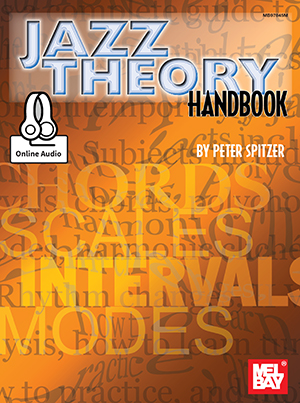
Jazz Theory Handbook is a complete guide to all the essential topics of jazz theory, suitable for all treble instruments. Its approach is clear and concise, realistic and practical. This book will help you to understand how contemporary jazz players think, and to apply theory concepts in your own playing. Subjects are introduced progressively, with each new one based on those introduced before. Topics include chord building, harmonic movement, modes, II-V-I licks.
Book + Online Audio
Mel Bay
Jazz Theory Handbook is a complete guide to all the essential topics of jazz theory, suitable for all treble instruments. Its approach is clear and concise, realistic and practical. This book will help you to understand how contemporary jazz players think, and to apply theory concepts in your own playing. Subjects are introduced progressively, with each new one based on those introduced before. Topics include chord building, harmonic movement, modes, II-V-I licks, polychords, blues, rhythm changes, how to learn tunes, practice techniques, playing outside, and more. All of the book's musical examples are performed on the accompanying audio, along with sample solos and 3 play-along tracks with a great rhythm section. Jazz Theory Handbook is designed for both self-study and classroom use. Includes access to online audio.
Introduction
Chapter 1 - Intervals and Scales
1. Half steps and whole steps
2. Major scales
3. Circle of fifths
4. Intervals-how they are named
5. Hearing intervals
6. Minor scales
7. Other scales you should know
8. Transposing
9. Exercises
Chapter 2 - Chord Building
1. Triads
2. Seventh chord vocabulary
3. Seventh chords in major; Roman numeral notation
4. Seventh chords in minor
5. Extensions and "avoid" notes
6. Polychords/upper structures
7. Exercises
Chapter 3 - Chord Movement: Harmonic Cliches
1. V to I
2. Circle of dominants
3. IlVI
4. Circle of fifths within a key
5. Deceptive cadences
6. Common tones
7. Secondary dominant
8. Substitute dominant
9. Pivot chords
10. IV m and b Vlldom, modal interchange
11. Turnarounds, tags, vamps
12. Exercises
Chapter 4 - Modes and Chord Scales
1. Scale tones as chord extensions
2. Modes of major
3. Modes of major, continued
4. Modes of melodic minor
5. Whole tone and diminished scales
6. Bebop scales
7. Pentatonic scales
8. Exercises
Chapter 5 - Blues
1. Blue notes and the blues scale
2. Basic blues progression
3. Dominant I and IV
4. Variable third
5. Bebop blues
6. Minor blues
7. "Bird blues" and other variations
8. Sample solo
Play-along track-Blues in F
9. Exercises
Chapter 6 - Rhythm Changes
I. Chord chart and analysis
2. Improvising on Rhythm changes
3. Variations on the progression
4. Sample solo
Play-along track-Rhythm changes in Bb
5. Exercises
Chapter 7 - Approaches to Improvising
1. Beyond theory
2. "Outside" playing
3. About "originality"
4. Exercises
Chapter 8 - Learning Tunes
1. Suggestions for learning tunes
2. Tips on analyzing harmony
3. Form
4. Interpreting lead sheets
5. Memorizing tunes
6. Exercises
Chapter 9 - Sample Analysis:
"After You've Gone"
1. Lead sheet and analysis
2. About this tune
3. Lyrics
4. Bar-by-bar comments
5. Sample solo
Play-along track-"After You've Gone" in C
6. Exercises 1
Chapter 10 - Suggestions for Further Study
1. Listen, practice, analyze, perform
2. Practice routines
3. Exercises for basic technique
Appendix A - II V I licks
Appendix B - The logic behind the chord scale system
Appendix C - Solos for Bb and Eb instruments; chord charts for play-along tracks
Appendix D - Selected bibliography